
Upton Release Date Labels
TDCJ uses several date labels that answer different questions. A parole eligibility date marks when review may become available. It does not promise approval. The projected release date is a calculated estimate or discharge framework tied to offense date, offense type, and applicable release law. After release information and a certificate are processed and audited, TDCJ may show a scheduled release date and scheduled release location.
Scheduled is not actual: TDCJ warns that a scheduled date can change without notice, even on that date.
| Date | Meaning | Does it prove release? |
|---|---|---|
| Parole eligibility | A review threshold under the governing law | No |
| Projected release | A TDCJ calculation tied to sentence and release law | No |
| Scheduled release | An operational plan after processing | No |
| Actual release or discharge | A completed custody event | Yes, for the named custodian |
The evidence ladder runs from eligibility, to projection, to Board action, to scheduling, and finally to the release or discharge record. Do not collapse the stages.
Find Upton Projected Release Dates
First identify the custodian. Upton County Jail and TDCJ calculate different kinds of sentences. The TDCJ Online Inmate Search applies after a state transfer. A county sentence remains with the Upton judgment and Sheriff's jail calculation.
- Check the Upton criminal docket for the judgment, sentence, jail credit, and any later order.
- Ask the Sheriff whether the person remains at Upton County Jail or moved to another custodian.
- For TDCJ custody, search by TDCJ or SID number when known, then verify identity and county of conviction.
- Read current facility, parole eligibility, projected release, and review fields separately.
- If the online record is missing or unclear, use TDCJ email or phone with the full name, seven-digit TDCJ number, or date of birth and county of conviction.
- After the expected date, obtain the actual release, discharge, or supervision record.
TDCJ lists projected release date among the public inmate information available through its email path. It states that this convenience service has no charge and does not provide photographs or Social Security numbers.
Note: Keep the TDCJ number and court cause because former prisoners may not remain visible in a current-inmate search.
Upton TDCJ Date Definition
The official TDCJ inmate-information instructions define Projected Release Date and explain how offense date and release eligibility affect it. That source is stronger than a hand-built sentence calculator because the controlling law is not one formula.
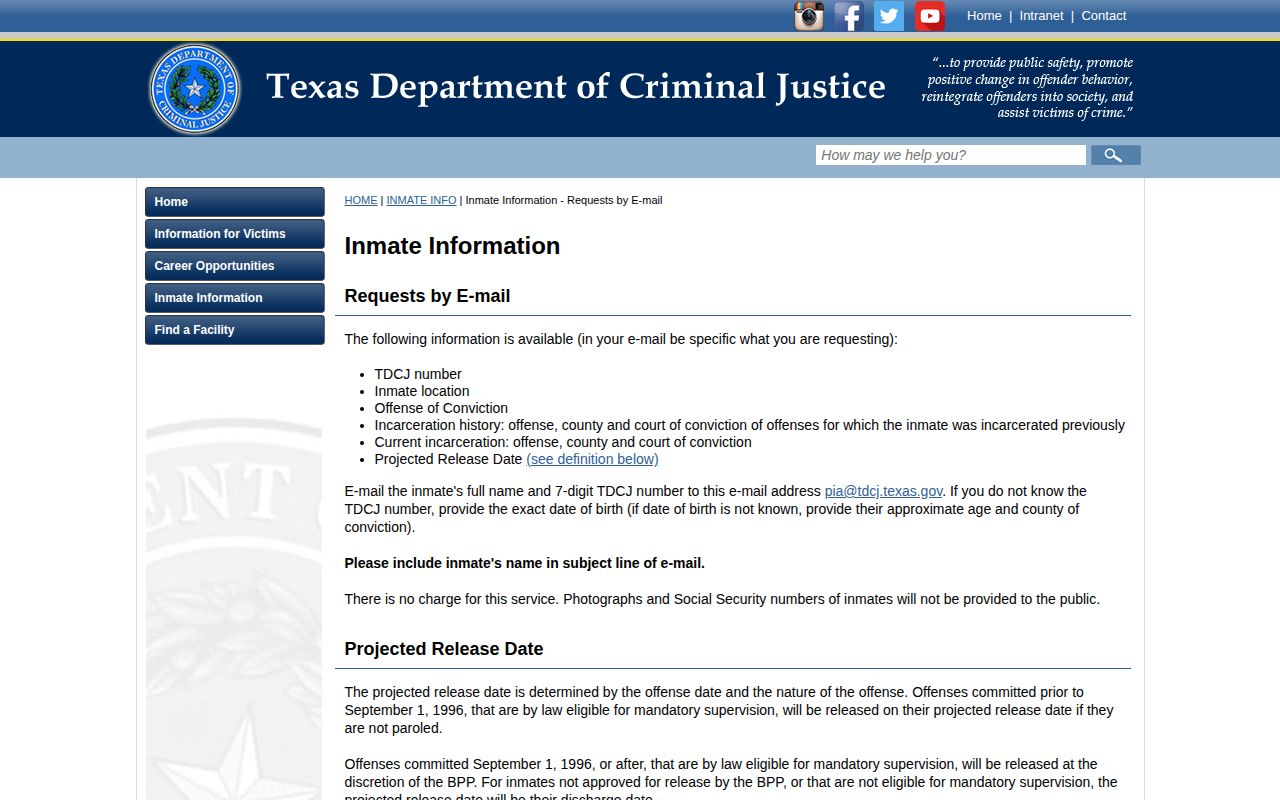
The official definition shows why the projection must be read with eligibility, Board action, and later scheduling.
For eligible offenses committed before September 1, 1996, the projected date can function as a mandatory-supervision release date when parole has not occurred. For later eligible offenses, discretionary review by the Board matters. If a person is not approved or is ineligible, the projection may instead be the discharge date. Offense date is essential.
Upton Good-Time Release Rules
Texas Government Code Chapter 498 governs good conduct time. Section 498.003 permits eligible TDCJ inmates to earn credit based on classification and rules. The same statute makes the key limit clear: good conduct time affects eligibility for parole or mandatory supervision and does not otherwise reduce the sentence imposed by the court.
Credit can be forfeited, and restoration is limited by law and policy. That means a simple subtraction of “good days” from a prison term does not produce a sound Upton release date. Eligibility also varies with the offense, deadly-weapon findings, sentence, special categories, and the version of law in force on the offense date.
- Good conduct time
- Credit used in certain eligibility calculations, not a rewrite of the sentence.
- Calendar time
- Actual elapsed time served.
- Parole eligibility
- The point at which review may occur, not an order to release.
- Detainer
- A request or hold from another authority that can prevent community release.
No Upton 85 Percent Rule
Texas has no universal rule that every state prisoner serves 85 percent. Government Code Chapter 508 uses offense-specific and date-specific parole and mandatory-supervision provisions. Some serious-offense rules use actual calendar time and statutory fractions, while other cases combine calendar and good-conduct time. Exclusions also apply.
Upton County publishes no local jail good-time schedule or weekend or holiday early-release formula. A county sentence requires the judgment, start date, presentence jail credit, concurrent or consecutive terms, and the Sheriff's calculation. TDCJ's state-prison projection should never be applied to an Upton misdemeanor jail term.
Changes to Upton Release Dates
Dates move for legal and operational reasons. A change does not always mean an error, but it should be traced to an official record.
| Change | Possible effect | Where to verify |
|---|---|---|
| Jail-credit correction | Moves sentence computation | Judgment, court order, custodian |
| Classification or forfeiture | Changes eligibility credit | TDCJ records |
| Board denial or approval | Changes parole path | BPP decision status |
| Required program or plan | Delays release processing | TDCJ/BPP status |
| New detainer or sentence | Blocks community exit or causes transfer | Custodian and court records |
| Records audit | Adjusts scheduled date | TDCJ release processing |
A favorable Board vote can still precede program completion, plan approval, a certificate, and a records audit. A denial may create a later review date. Neither event alone says where the person is today.
Upton County Jail Calculations
A pretrial detainee has no fixed sentence-release date. Bond, dismissal, a court order, or another custody event may end the booking, but any other hold can block the physical exit. For a sentenced county inmate, obtain the judgment from the Upton criminal portal and ask the Sheriff for the custody calculation and actual release event.
Presentence credit, concurrent or consecutive terms, and later court orders can alter the computation. A docket disposition explains the legal result, while the jail log establishes when processing ended. If the jail says the person transferred to TDCJ, switch systems instead of treating the end of the Upton booking as community release.
The more detailed Upton County release record search identifies the jail fields and court entries that can confirm the completed event.
Upton Release Holds and Transfers
A detainer, warrant, federal writ, immigration hold, or another county case can keep custody in place after one sentence or booking ends. Ask for the destination or transfer agency. “Released from Upton County Jail” may only mean the local custodian handed the person to TDCJ, USMS, ICE, or another county.
For state custody, use TDCJ. For federal sentenced custody, use BOP and the federal docket. ICE has its own locator. An Upton roster absence, notification, or projected date cannot rule out those separate systems.
Confirm Upton Actual Release
Once the expected date passes, replace the forecast with a historical record. Ask the responsible custodian for the actual release or discharge date, release type, and destination. For conditional state release, check the Parole Division or IVSS status. The Upton VINELink release check can provide an alert, but agency confirmation remains the final step.
A released state prisoner may disappear from a current-inmate search. Use the saved TDCJ number, official information channels, court judgment, and supervision record. For an Upton jail-only sentence, rely on the Sheriff's release event and county court cause instead.
Upton Mandatory Supervision Dates
Mandatory supervision is not the same as an automatic sentence reduction. Government Code Sections 508.147 through 508.149 govern the route and list exclusions. For eligible pre-September 1996 offenses, the projected date can serve as the mandatory-supervision date if parole has not occurred. For later eligible offenses, the Board's discretionary process can affect whether release occurs before discharge.
Read the offense date and exact status. A projected date without a Board decision or later scheduled information should stay labeled as a projection. An approval still may require release processing, a certificate, a plan, and clearance of holds. After the event, confirm supervision through TDCJ or the assigned Parole Division office.
Upton Court Credit Details
County and state calculations both depend on accurate source data. A judgment may award credit for days held before sentence, specify whether terms run at the same time or one after another, and identify the offense of conviction. A later order correcting a clerical mistake can change the calculation without changing the sentence itself.
Use the filed judgment rather than an arrest charge list. Charges can be dismissed, reduced, or resolved under a different count. Ask the custodian which existing calculation record supplies the displayed date, but do not ask a records officer to predict a judge's future action. If credit appears wrong, the court file and counsel are the proper legal paths; a public search result cannot amend a sentence.
Note: An estimate based on an arrest charge may be wrong after plea, dismissal, sentencing, or correction of jail credit.